Born in Fez
Born on 16 May in Fez, Morocco, into a family working in traditional trade and clay products.
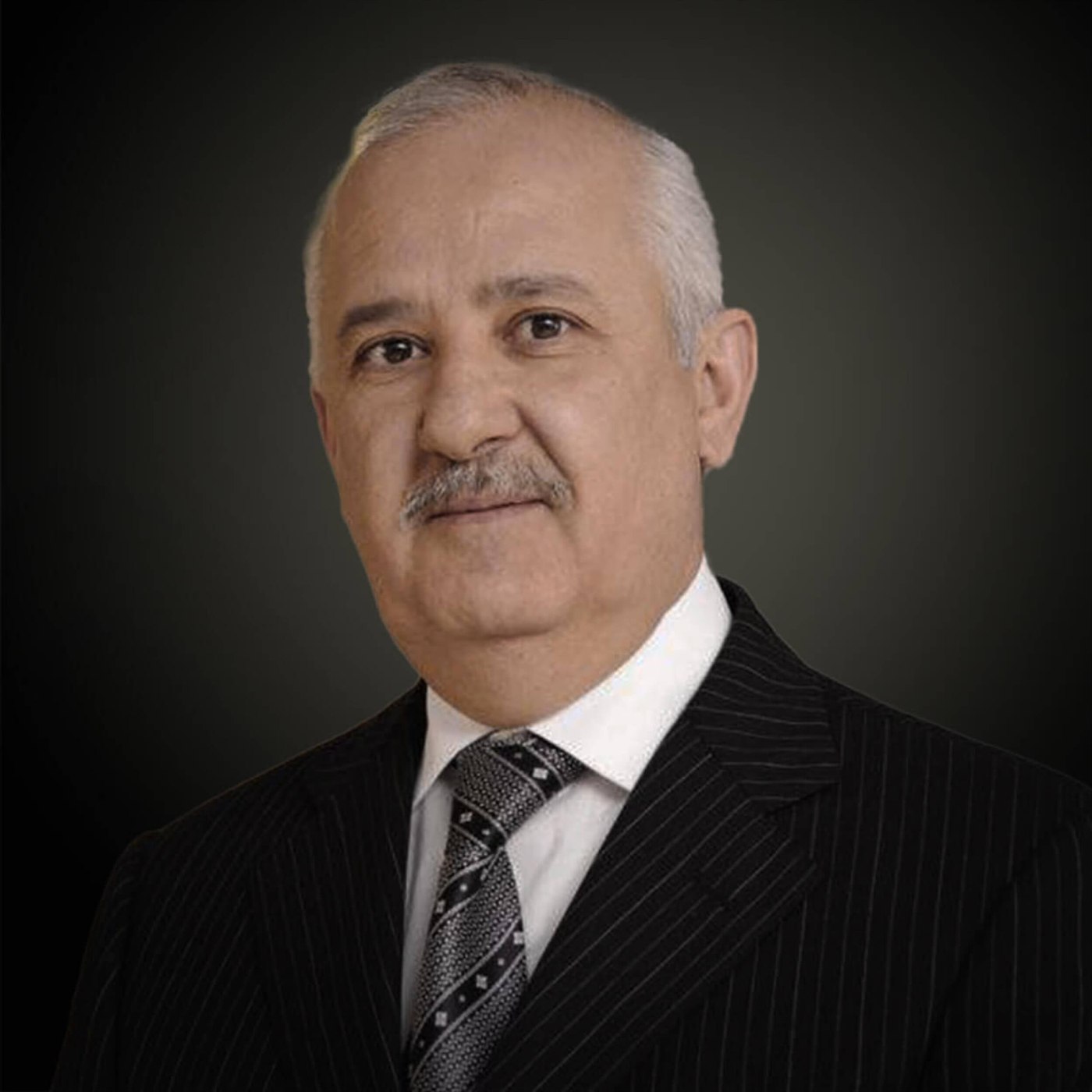
Moroccan entrepreneur Founder & chairman, Groupe Addoha Casablanca
He began in a family trading business in Fez, founded a property company in Casablanca in 1988, and turned the unglamorous business of building affordable homes into one of Morocco’s largest listed industrial groups — then carried the same model into eleven African markets.
All figures on this page are attributed. Where a number is an external estimate rather than a company disclosure, it is labelled as such. See Sources & References.
Introduction
Anas Sefrioui’s career is unusually legible. It runs along a single line — housing — and every diversification he has made since has been an attempt to control more of that line, from the cement in the walls to the land under the foundations.
Anas Sefrioui was born in Fez on 16 May 1957. He left secondary school early to work alongside his father, Haj Abdeslam Sefrioui, in a family business producing a traditional washing clay — the ghassoul long used across Morocco for hair and skin. It was a small, physical, margin-sensitive trade, and it was where he learned the disciplines that would later define a listed company: sourcing, pricing, distribution and the patience required to sell a low-cost product in very large quantities.
In 1988 he founded Douja Promotion Groupe Addoha in Casablanca. Morocco at the time was urbanising quickly and had a structural shortage of formal, affordable housing. Most private developers preferred the middle and upper segments, where margins per unit were comfortable and buyers were bankable. Sefrioui went the other way. He built at the bottom of the market, where the margin on any single apartment was thin, and made the economics work through volume, standardisation and speed of execution.
That decision is the hinge of the whole career. The group’s first significant programme, delivered from the mid-1990s, comprised 2,371 housing units at Aïn Sebaâ in Casablanca. From there the company scaled into successive state-supported housing conventions, listed on the Casablanca Stock Exchange in July 2006, and became, by unit volume, the reference name in Moroccan residential development.
The second act has been industrial and international. Sefrioui founded Ciments de l’Atlas (CIMAT) to produce cement in Morocco, then Ciments de l’Afrique (CIMAF) to do the same across West and Central Africa — a vertical move that put the group’s single largest input cost inside its own perimeter. Today Addoha builds in Morocco and in several sub-Saharan markets, while CIMAF operates in eleven African countries.
He is a Moroccan citizen, resident in Casablanca, married with three children. His daughter Kenza Sefrioui serves as deputy chair of Groupe Addoha. Forbes has carried him on its billionaires lists repeatedly and describes his wealth as self-made, derived from real estate.
Journey through time
Drag or scroll the rail to move through the record. Each entry is dated and sourced; the complete, annotated version is on the career timeline.
Born on 16 May in Fez, Morocco, into a family working in traditional trade and clay products.
Establishes his property development company in Casablanca, focused on economic and social housing.
Delivers 2,371 housing units at Aïn Sebaâ, Casablanca — the template for volume housing production.
Signs an initial convention with the Moroccan state covering a minimum of 3,500 units.
Floats 35% of the capital in July at MAD 585 per share — one of the exchange’s defining offerings.
Founds Ciments de l’Atlas; in December acquires 50% of Fadesa Maroc, bringing in the Mediterrania Saidia resort.
Adds a luxury brand, extending the group from social housing into the high-end segment.
Begins the group’s West African expansion, starting in Senegal, with CIMAF carrying cement across the region.
Introduces the mid-range Coralia brand and signs conventions with the Ivorian state.
Launches the “Priorité au Cash 2020” plan, shifting the group from expansion to balance-sheet repair.
IFC, Proparco and the Emerging Africa Infrastructure Fund arrange a €161.25m package for CIMAF’s West African capacity.
Commits more than MAD 3bn to a mixed-use tower complex in Abidjan’s Zone 4 — the clearest signal yet of the move upmarket.
Scroll horizontally →
Business & entrepreneurship
Volume housing is a manufacturing problem disguised as a property problem. The record suggests Sefrioui understood that earlier, and acted on it more completely, than most of his contemporaries.
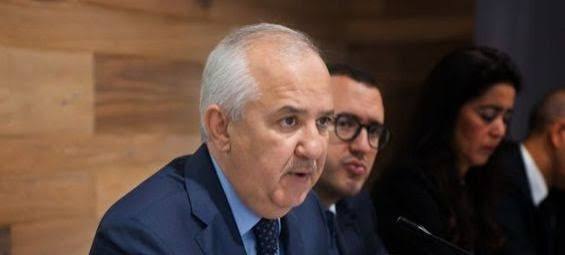
Addressing an industry gathering. Groupe Addoha’s scale has made its founder a recurring voice on Moroccan housing supply.
The founding insight was not that Morocco needed housing — everyone could see that. It was that the affordable segment, properly industrialised, could be more durable than the luxury segment, because its demand does not depend on the business cycle. Families form, cities grow, and the queue for a first home does not shorten in a downturn.
Making that thesis pay required a different operating model from the one Moroccan developers were using. Four choices stand out in the record:
Repeating a small number of apartment typologies across very large programmes compresses design cost, shortens build cycles and makes procurement predictable. It is closer to production engineering than to architecture, and it is what allows a thin per-unit margin to become a substantial absolute profit.
Addoha became known for housing bank branches, notaries and administrative services inside its own sales premises. For a first-time buyer on a modest income — often without prior banking experience — the friction of financing and registration was as much a barrier as the price. Removing that friction widened the addressable market without lowering the price.
From 2000 onward the group worked through conventions with the Moroccan state, under which developers committed to deliver defined volumes of housing at capped prices in exchange for fiscal incentives. Business-press coverage consistently identifies this alignment as central to the group’s growth — and, equally, as the reason its fortunes have tracked changes in national housing policy.
Cement is the largest single input into mass housing. Rather than remain a price-taker, Sefrioui built his own capacity: Ciments de l’Atlas in Morocco, with plants at Settat and Beni Mellal, and then Ciments de l’Afrique across sub-Saharan Africa. The cement business is now a substantial enterprise in its own right, independent of Addoha’s development pipeline.
The same logic explains the later diversification upward. Once the volume machine existed, adding Prestigia (2009) at the luxury end and Coralia (2015) in the middle used the same land bank, the same construction capability and the same procurement, against buyers with more purchasing power.
Groupe Addoha
Douja Promotion Groupe Addoha S.A. trades on the Casablanca Stock Exchange under the ticker ADH. It is the vehicle through which almost all of Anas Sefrioui’s development activity has been executed.
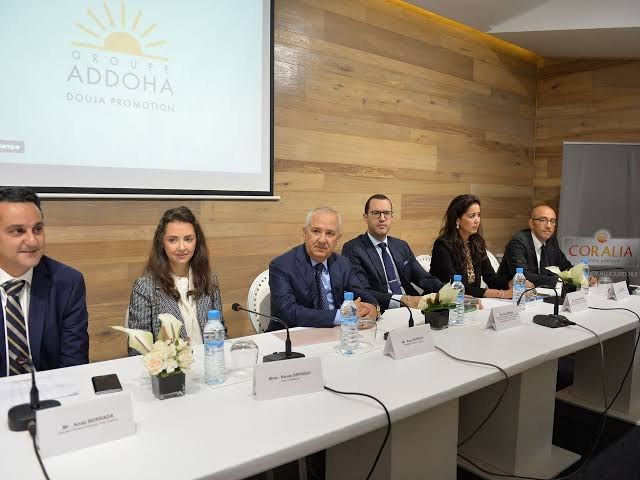
Anas Sefrioui with the Groupe Addoha management team at a company press conference. His daughter Kenza Sefrioui serves as deputy chair of the group.
Addoha operates across three residential segments under distinct brands. Addoha covers economic and social housing — described by the company as its historic business. Coralia and Excelia serve the mid-range, with apartments, villas and serviced land. Prestigia Luxury Homes addresses the high end in Casablanca, Rabat, Marrakech and Fez, and at coastal destinations including Tangier–Tétouan and Saidia.
The company reports having completed more than 148 projects across 19 Moroccan cities, totalling 257,517 units. Outside Morocco it has developed in francophone West and Central Africa since 2012, beginning in Senegal, with Prestigia extending to Côte d’Ivoire in 2019.
Its trajectory has not been linear. The 2006 flotation was followed by an extraordinary run in the share price — reported to have risen roughly sixfold within six months before falling back sharply — and the group spent much of the following decade absorbing the consequences of very rapid expansion. The “Priorité au Cash 2020” plan, launched in 2018, marked a deliberate turn from growth toward cash generation and debt reduction.
The most recent published results show that repair largely complete and a different company emerging: for 2025, revenue of MAD 2.7 billion (up 4%) and net profit of MAD 516 million (up 70%), with consolidated equity of MAD 10.4 billion, net debt held at MAD 4.385 billion and gearing around 30%. Secured revenue — contracted but not yet recognised — rose 22% to MAD 11.2 billion, of which about 28% is African.
Full-year 2025 figures as reported in business-press coverage of the group’s results. New Moroccan real-estate accounting rules effective January 2025 changed the timing of revenue recognition, which is why two revenue figures are cited.
Leadership & vision
No quotations are attributed to Anas Sefrioui anywhere on this site unless they can be verified in a primary source. What follows is drawn from documented decisions rather than from statements.
More than three decades after founding the company and two after listing it, Sefrioui still holds roughly 64.8% of Groupe Addoha. That is an unusual structure for a listed developer of this size, and it has consequences: strategy can turn quickly, capital allocation is not hostage to quarterly sentiment, and the founder carries concentrated exposure to his own decisions.
The move into cement — CIMAT in Morocco, CIMAF across Africa — is the clearest expression of his operating philosophy. In a business where the margin per unit is small, control of the largest input cost is not a side venture; it is a defence of the core.
The 2018 “Priorité au Cash” plan required the group to stop doing the thing it was best known for — building ever-larger volumes — and to prioritise collections, disposals and debt reduction instead. Founders often struggle to reverse the strategy that made them. The subsequent balance-sheet figures suggest this one did.
When Moroccan social housing matured, the response was not to abandon the model but to move it. Sub-Saharan Africa offered the same demographic arithmetic Morocco had presented in the 1990s: fast urbanisation, young populations, a shortage of formal housing and a scarcity of developers able to build at scale.
Kenza Sefrioui’s position as deputy chair places the next generation inside the governance of the group rather than adjacent to it — a structural answer to the question that eventually confronts every founder-controlled company.
Key milestones
Selected from the verified record. Each is dated, and each altered the structure of the business rather than merely extending it.
Douja Promotion Groupe Addoha is established in Casablanca. The founder has no formal training in development; what he brings is a merchant’s understanding of volume, price and distribution.
The first programme at genuine scale. It proves that thin per-unit margins can support a serious business if the volume and the execution speed are right — the finding on which everything after it rests.
Thirty-five per cent of the capital is placed in July at MAD 585 per share. The flotation gives the group permanent capital for land acquisition and makes a private family business publicly accountable.
Ciments de l’Atlas is founded, with plants at Settat and Beni Mellal. In December the group pays MAD 1.3 billion for 50% of Fadesa Maroc, bringing in the Mediterrania Saidia resort — more than 700 hectares on the Mediterranean.
Development activity extends into francophone West and Central Africa, beginning in Senegal. CIMAF builds cement capacity alongside it, eventually reaching eleven countries.
The group commits more than MAD 3 billion — roughly USD 300 million — to a mixed-use complex in Abidjan’s Zone 4, anchored by four twenty-storey residential towers and more than 150,000 square metres of usable floor space.
Morocco & development
Analytical context. This section describes the policy and demographic environment in which Groupe Addoha operates; it is not a claim about any individual company’s share of the outcomes described.
Morocco’s housing challenge in the late twentieth century was one of arithmetic. Rural-to-urban migration was fast, household formation was faster, and the formal construction sector was producing well below what the cities absorbed. The gap filled itself informally — in unregulated peripheral settlements that were expensive to service and politically difficult to leave in place.
The state’s response combined slum clearance and rehousing under the Villes Sans Bidonvilles programme with fiscal incentives that made low-price housing viable for private developers. The instrument was the convention: a developer committed to deliver a defined number of units at a capped price and received tax relief in return. It converted a social objective into an industrial order book — and it required developers capable of operating at industrial scale.
The scheme that ran from 2010 to 2020 gives a sense of the magnitude involved. Roughly 2.1 million units were contracted under it; reported sales figures put completions actually sold at 716,331, with 264,130 of those transacting after 2020. The gap between what was contracted and what was absorbed is itself the story of the decade, and it explains why the whole industry — Addoha included — spent the late 2010s recalibrating.
Policy moved again in 2024. Rather than subsidising developers, Morocco began paying buyers directly under a 2024–2028 housing aid programme: MAD 100,000 toward a home priced up to MAD 300,000, and MAD 70,000 for one priced between MAD 300,000 and MAD 700,000. Government and press reporting has put beneficiaries above 105,000 people, with the majority of applications falling in the upper band.
The shift matters commercially. Demand-side support raises what a buyer can afford rather than what a developer can deduct, which pushes the viable product slightly upmarket — toward exactly the mid-range segment Coralia was created to serve. Reported second-order effects have included stronger cement sales and a measurable increase in construction employment.
National housing statistics describe the market, not the performance of any single developer. Where this site connects Groupe Addoha to these programmes, it does so only where the connection is documented — for example, the group’s state conventions and its contracts for more than 5,000 rehousing units in Casablanca, Rabat and Marrakech.
Featured insights
Longer analytical pieces published across the site, each grounded in the documented record.

The full arc of the entrepreneurial journey: the family trade, the founding of Addoha in 1988, the state conventions, the flotation and the decade of consolidation that followed.
From supply-side conventions to the 2024 direct-aid model — and what each shift demanded of the developers operating inside it.
Why the pivot from volume to value came when it did, and how vertical integration into cement underwrote both phases.
An assessment of the wider footprint: construction employment, building-materials capacity and Moroccan corporate investment across Africa.
Forbes billionaires listings across successive years, Forbes Middle East’s Most Impactful Real Estate Leaders 2026, and the documented corporate milestones behind them.
Continue
Fifteen sections covering the biography, the business, the industry context and the sources behind every claim.