Economic analysis
Economic & industry impact
Housing production, cement capacity, construction employment and Moroccan corporate investment across Africa — the four channels through which the businesses Anas Sefrioui built connect to the wider economy.
A word on what “impact” can honestly mean here. Attributing macroeconomic outcomes to a single company is almost always unsound, and no reliable source apportions Morocco’s housing or employment figures to individual developers. This page therefore separates two things carefully: what the businesses verifiably do, and what the national context around them looks like.
Company & national figures: sourced Causal reasoning: editorial
Channel one
Housing production at industrial volume
The most direct effect of a volume developer is the physical stock it adds — and the households that occupy it.
Groupe Addoha reports 257,517 units delivered in Morocco across more than 148 completed projects in 19 cities. That is a large number in absolute terms, and it is worth being precise about what it represents: dwellings built and handed over, the majority of them in the economic and social segment, over roughly three decades.
The economic significance of formal housing at this price point is not only that people are housed. It is that they are housed with title. A registered dwelling can be mortgaged, insured, inherited and sold. It converts a household’s largest expenditure into a recorded asset, and it brings the transaction inside the tax and financial system. Informal settlement does none of these things, which is why the difference between formal and informal supply matters more than the raw count of roofs.
The current production position points outward as much as inward. At the end of 2025 the group had more than 26,000 units under construction across projects worth close to MAD 21 billion — about 30% of them in West Africa. The same industrial model that supplied Casablanca and Marrakech now supplies Abidjan, Dakar and Conakry.
Channel two
Cement, and the industrialisation of an input
The building-materials businesses are the less visible half of the story, and in developmental terms arguably the more consequential.

Why cement is different
Cement has a property that makes it unusually strategic in developing markets: it is heavy relative to its value, so transporting it far destroys the economics. A country without domestic capacity imports at a structural cost penalty, and every road, school, clinic and apartment built there is more expensive as a result.
Building local capacity therefore does something that importing cannot. It lowers the delivered cost of construction across the whole economy, not only for the plant’s owner — and it creates industrial employment, technical skills and tax revenue in the country where the plant stands.
Ciments de l’Atlas operates in Morocco from plants at Settat and Beni Mellal, each reported at 1.6 million tonnes of capacity. Ciments de l’Afrique operates across eleven African countries: Côte d’Ivoire, Guinea, Cameroon, Burkina Faso, Gabon, the Republic of Congo, Mali, Mauritania, Ghana, Chad and Guinea-Bissau, with early facilities outside Morocco reported at around 500,000 tonnes each.
The development-finance view
The clearest external assessment of this activity came in 2021, when the International Finance Corporation, Proparco and the Emerging Africa Infrastructure Fund arranged a €161.25 million financing package for CIMAF to expand cement production in West Africa, explicitly framed as meeting rising regional demand.
These are development finance institutions with mandated development objectives, and their investment decisions follow lengthy technical, environmental and social review. That three of them committed jointly is a substantive signal about how the business is assessed from outside.
Reporting in 2026 has described a further refocusing of CIMAF toward the African continent, with the founder progressively concentrating activity there.
The general economic reasoning about local cement capacity applies to the sector as a whole. It is not a claim that any specific outcome in any specific country is attributable to CIMAF.
Channel three
Construction, employment and the wider cycle
National figures, presented as national figures. They describe the environment in which Groupe Addoha operates.
The gap between 2.1 million units contracted and 716,331 sold is the single most instructive statistic in Moroccan housing. It shows that commissioning supply and generating completed sales are different problems, and that a decade of supply-side policy solved the first far more effectively than the second.
The 2024–2028 direct-aid programme attacks the second problem instead, paying buyers rather than developers: MAD 100,000 toward a home priced up to MAD 300,000, MAD 70,000 for one between MAD 300,000 and MAD 700,000. Reported effects of the programme include cement sales up 12.5%, housing loans up 3% and around 74,000 additional construction jobs.
Those employment and materials figures illustrate how tightly the construction sector is coupled to housing demand — and why a developer with its own cement capacity is exposed to that cycle twice over, once through units sold and once through tonnes shipped.
Every figure in this section is a national total drawn from Moroccan government communications and press reporting. None of it is apportioned to Groupe Addoha, because no reliable source apportions it.
Channel four
Moroccan capital moving south
One of the more significant patterns in African business over the past fifteen years, and one in which the businesses Sefrioui built are an early and substantial participant.
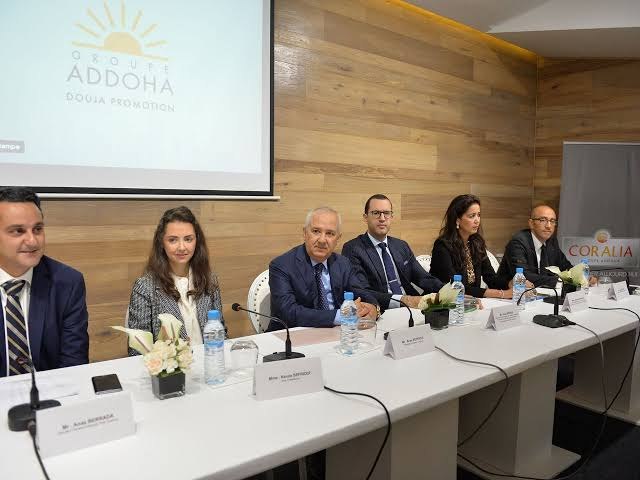
Groupe Addoha’s expansion since 2012 forms part of a broader movement of Moroccan corporate investment into West and Central Africa.
Since roughly 2010 Moroccan companies — in banking, telecommunications, insurance, building materials and property — have expanded across francophone West and Central Africa in numbers that have made Morocco one of the continent’s more significant sources of intra-African investment.
The businesses associated with Anas Sefrioui are a substantial part of that pattern. Development activity began in Senegal in 2012 and now covers Côte d’Ivoire, Senegal, Guinea, Gabon and Cameroon. CIMAF reaches eleven countries. Conventions were signed with the Ivorian state in 2015, mirroring the Moroccan model of partnership with public housing policy. Addoha has been named among five operators selected for Ghana’s social housing programme.
Two features distinguish this kind of expansion from portfolio investment. It is fixed and long-dated: a cement plant or a housing programme cannot be withdrawn at short notice. And it is capability transfer rather than capital transfer — what crosses the border is an operating method for producing housing and materials at volume, which is precisely what markets at this stage of urbanisation lack.
The February 2026 Abidjan commitment — more than MAD 3 billion for four twenty-storey towers, offices and retail across over 150,000 square metres — marks a further stage: not affordable housing exported southward, but premium development undertaken abroad on its own commercial terms.
Continue
Related reading
Company detail, industry policy and the sources behind these figures.